
blog
Gmail Promotions or Spam? Check Where Your Campaign Landed
Learn the difference between Gmail Promotions and spam, test a real Mailchimp or Klaviyo campaign, and choose the right next step from the result.
Finding your campaign in Gmail Promotions can feel like a deliverability failure. It is not the same as spam.
Promotions is a delivered Gmail inbox category for deals, offers, and other marketing email. Spam sits outside the normal inbox experience. The useful first step is to identify which result you actually have, then decide whether the campaign needs a change.
Gmail Promotions vs spam
| Result | What it means | Sensible next step |
|---|---|---|
| Primary | Gmail placed the message in the main inbox tab for that recipient. | Confirm the email is readable and the CTA works. |
| Promotions | Gmail delivered the message to its category for offers and promotional email. | Decide whether that category fits the campaign and audience. |
| Spam | Gmail classified the message outside the inbox as unwanted or suspicious. | Check authentication, sender history, list quality, complaints, links, and the received message. |
| Pending | The controlled observation is not complete. | Wait; do not record it as spam or not received. |
| Not received | The test did not observe the message during its window. | Check the campaign audience, suppression, marker, send log, and provider response. |
Google describes Promotions as the category for deals, offers, and other promotional messages. Gmail users can move a message between categories, and Google says those moves help Gmail learn that user's preferences. This is one reason two subscribers can see the same campaign differently.
Promotions therefore does not prove that Gmail distrusts your sender. Spam is the result that should start a deliverability investigation.
Identify the result you actually have
Start with the most direct evidence available.
If a colleague found the message in Promotions, record the Gmail account type, campaign, date, and whether the inbox uses Gmail's default categories. If a recipient says "it went to spam," ask for the folder name or a screenshot with private details removed. A message in Promotions is not evidence of spam, and an absent message is not evidence of either result.
Your ESP's delivered count cannot settle this distinction. Delivered usually means the receiving system accepted the message. It does not identify the tab or folder Gmail selected inside the mailbox.
A controlled seed test adds that missing observation. A seed list is a small set of test inboxes at providers such as Gmail and Outlook. You send the finished campaign to those addresses, then review the folder or category observed for each account.
Test the real Mailchimp or Klaviyo campaign
Use the campaign you intend to launch, not a simplified email sent from a personal mailbox. Keep the same:
- authenticated From address and sending domain
- ESP sending path
- subject and preheader
- HTML, images, links, and tracking
- footer, preference, and unsubscribe content
- representative personalization
Then create a fresh MailSlurp inbox placement run. Copy its current marker and seed addresses, add the seeds to a controlled test audience in your ESP, include the marker exactly as instructed, and send only to that audience.
Follow the provider-specific steps for Mailchimp inbox placement testing or Klaviyo inbox placement testing. Those guides show how to prepare the audience, preserve the marker, send the campaign, and wait for the completed result.
Do not reuse seed addresses from an article screenshot or an older run. The active marker and current seed list connect one campaign revision to one result.
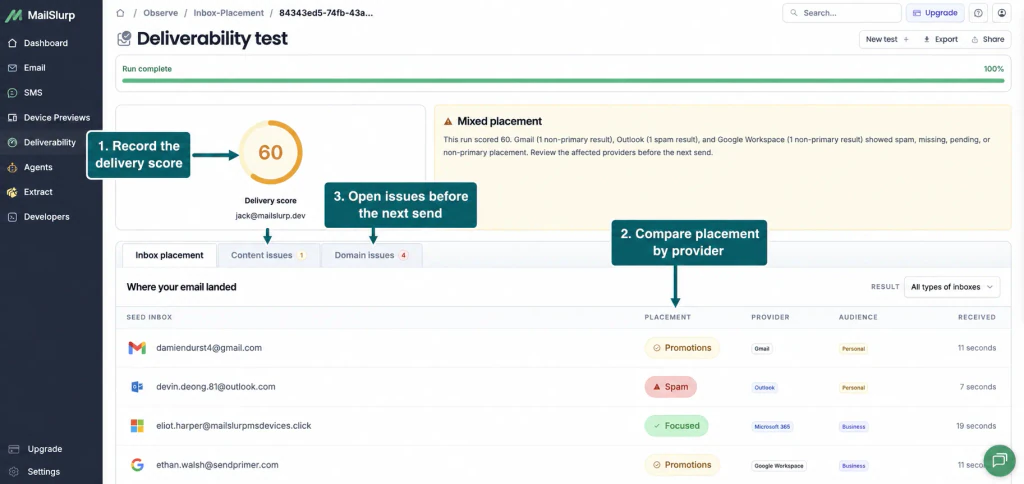
The completed result above shows why provider rows matter. Gmail and Google Workspace placed the campaign in Promotions. Outlook placed it in Spam. Microsoft 365 placed it in Focused. One message produced several observed outcomes, so "the campaign went to spam" would be too broad.
The run also does not forecast every subscriber. Recipient history, inbox settings, filters, and company policies can produce different results. Its value is a repeatable comparison against controlled accounts.
If Gmail says Promotions
First ask whether the result fits the message. A product sale, newsletter sponsorship, seasonal offer, or cart campaign belongs naturally in a promotional context. Reaching Promotions may be a normal delivered result rather than a defect.
Evaluate the campaign as a campaign:
- Does the From name clearly identify the sender?
- Did recipients consent to this kind of message?
- Is the offer useful to the selected segment?
- Does the subject match the content?
- Is the frequency reasonable for this audience?
- Can the recipient change preferences or unsubscribe easily?
Avoid tricks that promise to force Primary. Gmail classification includes recipient-specific behavior, and Google explicitly allows users to train their own category preferences by moving messages. Removing every image, button, or commercial phrase can make the email less useful without controlling the result for every recipient.
If a willing subscriber wants the message in Primary, they can move it there. That preference belongs to their inbox. Your job is to send recognizable, relevant, authenticated email that earns continued attention.
If Gmail says Spam
Treat spam as a different investigation. Start with sender and audience evidence before rewriting the whole campaign.
- Verify SPF, DKIM, and DMARC for the visible sending domain.
- Review complaint, bounce, and unsubscribe trends in the ESP.
- Confirm the audience was collected with clear consent and that suppressions are current.
- Check for a sudden change in volume, sending domain, IP, From address, or tracking domain.
- Inspect links, redirects, message structure, and the received headers.
- Correct one supported problem and run a fresh placement test.
Google's email sender guidelines cover authentication, DNS, TLS, message format, spam rates, and unsubscribe requirements. Use the requirements that apply to your sending volume, then compare the revised campaign against the same provider set.
A message-level spam score can help locate content or authentication risks. It still does not replace a folder observation. A low score is not proof of inbox placement, and a high score is not a Gmail tab label.
Record changes without treating one inbox as universal
Keep a short comparison for every meaningful retest:
| Field | Example of a useful record |
|---|---|
| Campaign | Autumn launch, approved HTML revision 3 |
| Sending path | Klaviyo campaign from the authenticated marketing subdomain |
| Completed result | Gmail Promotions; Outlook Inbox; Microsoft 365 Focused |
| Change | Removed a broken redirected link and preserved everything else |
| Retest | Fresh run, same sender and provider set |
| Decision | Approve placement; continue normal campaign monitoring |
This makes the conclusion traceable. If the result changes, you know what changed with it. If the result stays the same, you have not spent the test changing five unrelated variables.
Frequently asked questions
Is Gmail Promotions bad for email marketing?
Not automatically. Promotions is a normal inbox category for offers and marketing messages. Judge it against the campaign's purpose, audience expectations, and real engagement rather than treating the category as spam.
Is Promotions the same as the spam folder?
No. Promotions is part of Gmail's categorized inbox. Spam is outside the normal inbox experience and calls for a sender, audience, authentication, and content investigation.
Can I guarantee that a campaign reaches Primary?
No single sender change controls every recipient's category. Gmail users have their own history and preferences, and they can move messages between tabs. Use controlled tests to observe results, not to promise universal placement.
Can MailSlurp tell me where a real campaign landed?
Yes. Send the marked campaign to the current MailSlurp seed list and review the completed provider rows. Use the Mailchimp placement guide or Klaviyo placement guide for the exact ESP workflow.
Make the next decision from the completed result
Promotions asks, "Does this category make sense for the campaign?" Spam asks, "Which sender, audience, authentication, or message problem does the evidence support?" Pending asks you to wait.
Keep those outcomes separate, test the finished campaign, and change one thing at a time. Check your next campaign with MailSlurp inbox placement testing.